Peptavo is Jointly Accredited for 20 CME hours. Learn more about accreditation
PEPTAVO



The Stack Source LLC1908 E 11th Street Austin, TX 78702support@peptavo.com(512) 827-8158DBA: Peptavo
Peptavo is Jointly Accredited for 20 CME hours. Learn more about accreditation
Get volume discounts if you are getting 3 or more clinicians certified
Book a Call
The credential attests to ten modules passed under assessment, up to twenty accredited CE credits, seventeen hours of advanced curriculum, and a public registry entry any patient can check.

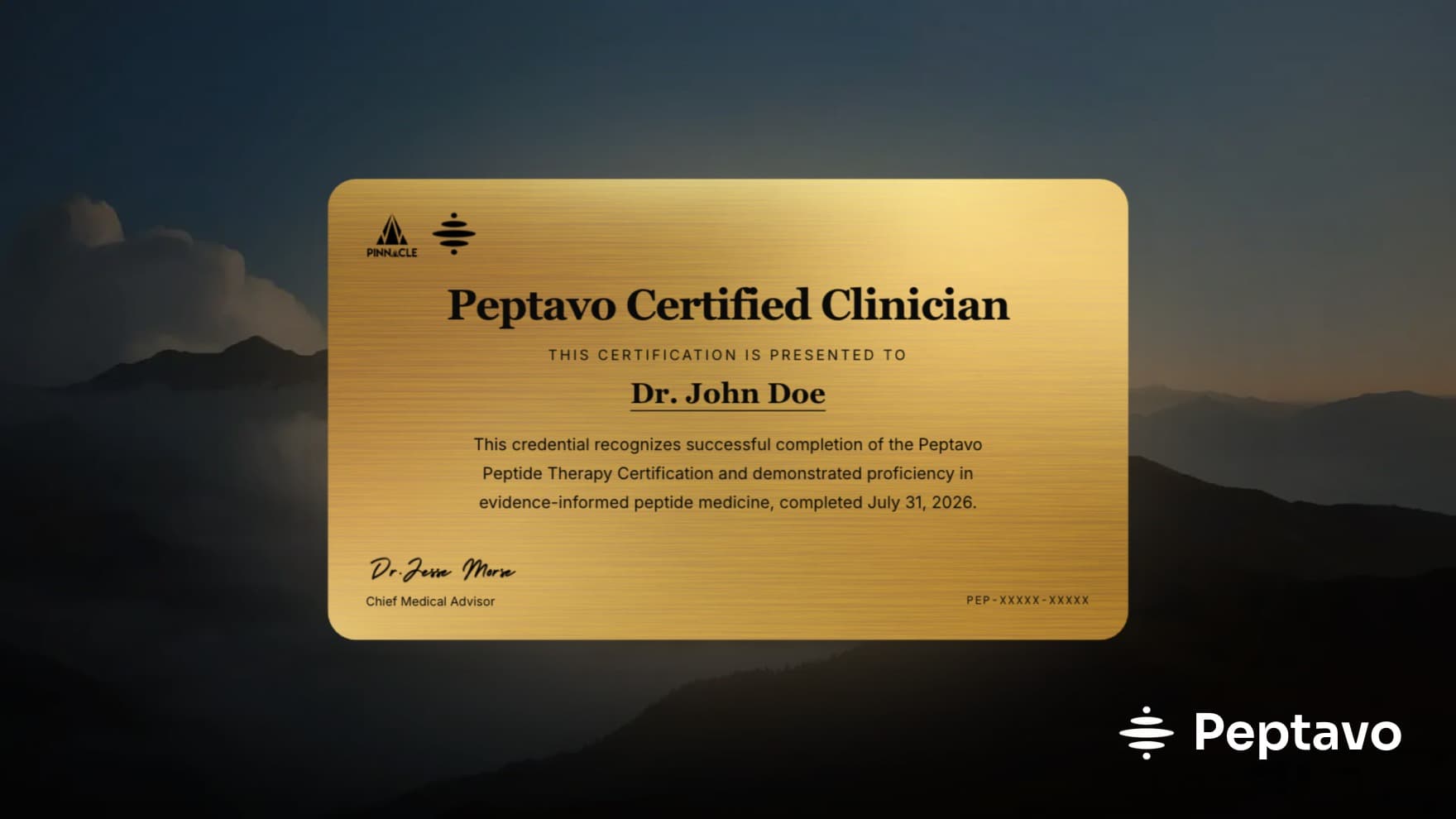
A Peptavo Certification is the permanent record of a specific body of completed clinical work. It is issued when a clinician passes the graded quiz in every one of Modules 1 through 10 at 75 percent or better, inside a curriculum that runs from peptide pharmacology through prescribing, sourcing, dosing, safety monitoring, and the regulatory boundaries that govern all of it. Modules 11 and 12 stay available afterward as bonus material, which means the credential marks the ten modules the program treats as the core of competent practice. Every attempt is graded on the server, and the earn date is stamped by the attempt that completed the set. A certified clinician therefore holds a dated attestation that they worked through the entire curriculum and demonstrated command of it under assessment, one module at a time.
That same body of work carries formal continuing education accreditation. Modules 1 through 10 make up an activity planned and implemented with Pinnacle Conference, LLC, which is jointly accredited by the ACCME, the ACPE, and the ANCC to provide continuing education for the healthcare team. The activity designates up to twenty credits across seven professional designations: AMA PRA Category 1 Credits for physicians, NCPD contact hours for nurses, CPE Monitor credit for pharmacists, AAPA Category 1 CME for physician assistants, ADA-CERP hours for dentists, BOC Category A hours for athletic trainers, and an AMA PRA Category 1 participation certificate for everyone else on the team. Sixteen of those hours are identified as pharmacotherapeutic content, which nurses and nurse practitioners may self-report as pharmacology credit. Joint accreditation is earned by surviving independent review of content, planning, faculty disclosure, and commercial independence before a single credit is designated. The twenty credits a Peptavo-certified clinician can claim are credits their licensing board already recognizes.
After the three foundation modules comes the clinical core. Modules 4 through 12 hold seventeen hours of content, including nearly seven hours of video, covering more than thirty peptide protocols, taught at the level of detail a prescriber needs on a Tuesday afternoon with a patient in the room: mechanism, candidate selection, dosing, duration, stacking, contraindications, and what to watch for at follow-up. Eight real patient cases are worked end to end, from presentation through workup and protocol selection to the monitoring schedule, and each one ships as a downloadable PDF that can be copied directly into practice. A condition-specific library of one-page protocol cards covers the common indications in the format a busy clinic actually uses. Procedure demonstrations walk through reconstitution and injection technique on camera, so the first vial a clinician handles is not the first one they have seen handled.
The certification also covers the part of peptide practice that has nothing to do with pharmacology. Certified clinicians have been taught the regulatory map that most of the field navigates by rumor: what 503A and 503B compounding pharmacies can and cannot make, how the FDA bulks list works and what its categories mean for a given molecule, why a vial labeled for research use only carries the label it does, and where the line sits between a legitimate compounded therapy and a product a patient found on the internet. They have also worked through a pricing and packaging playbook that turns the clinical knowledge into a defensible service line, with the program design, consent process, and follow-up cadence that keep a peptide practice both profitable and clean. That combination is rare. Plenty of clinicians know the molecules, and plenty of practices know how to package a program. The certification requires both.
What makes the credential legible to the outside world is that it can be checked. Every certification carries a unique certificate number and, by default, an entry in a public registry, so any patient, referring physician, employer, or malpractice carrier can confirm in a few seconds that the credential is real and still active. A clinician can switch that listing to private from their dashboard, which stops the number from resolving. The registry reflects live status, including revocation, which is the feature that gives the credential its weight: a certification that can be taken away is a certification that means something while it is held. When a Peptavo-certified clinician tells a patient that peptide therapy is inside their scope, that claim now traces back to ten passed assessments, up to twenty accredited CE credits, a documented curriculum, and a verifiable record with their name on it. That is the difference between a clinician who has read about peptides and a clinician who has been assessed on them.